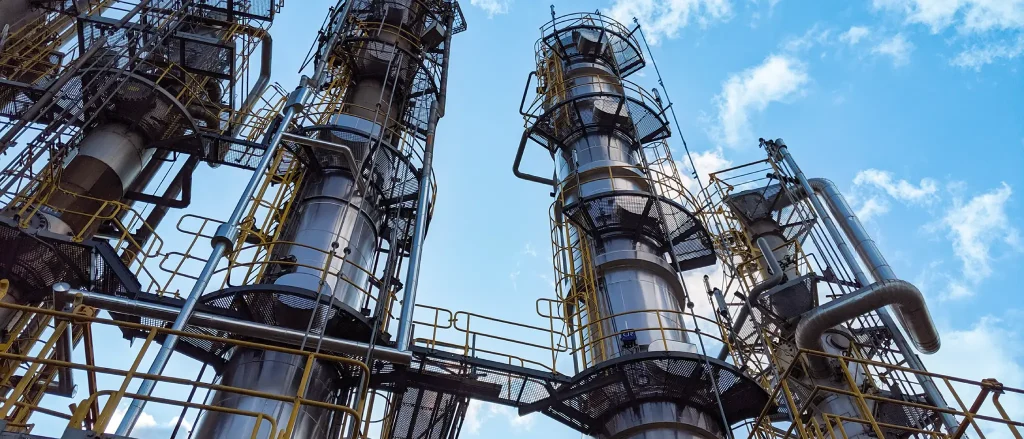
A practical step to Industry 4.0: Installing CorrosionRADAR’s CUI Monitoring Technology
Corrosion under insulation (CUI) is a common problem in the oil and gas, chemical, and power industries. It occurs when moisture penetrates insulation and comes into contact with the metal substrate, leading to corrosion, which can cause catastrophic failures. Traditional methods of inspecting for CUI involve costly and time-consuming localised inspections. However, with advances in Industry 4.0, a more sustainable approach is now available.
What do we do?
CorrosionRADAR offers a fully automated solution that provides corrosion and moisture monitoring and data analysis, enabling customers to gain insight into the environment hidden underneath their insulated assets. By detecting and locating potential corrosion issues, asset owners are able reduce risk and address problems before they become critical and costly.
How does it work?
CorrosionRADAR’s CUI monitoring technology is a non-invasive and wireless solution that continuously monitors for CUI, reducing the need for localised inspections. The system utilises sensors that are installed between the asset and insulation, and measurements may then be transmitted to our Clarity Dashboard for analysis and visualisation.
Why install it?
Installing CorrosionRADAR’s CUI monitoring technology has several benefits:
Continuous monitoring: The system provides continuous monitoring, meaning asset information is available between scheduled inspections.
Early detection: The system can detect problems at an early stage, allowing for proactive maintenance and repair; reducing the risk of catastrophic failures.
Localisation: Detections are localised on the asset, meaning inspection works can be targeted and streamlined.
Cost-effective: Installing the system enables the cost-effective use of resources compared to traditional time-based asset management methods.
Step 1: Understand client needs
The first step in the process is to understand our client’s needs with respect to safeguarding asset integrity, their current maintenance philosophies, and their vision for future management practices. We work together to map the journey towards enabling a smarter and more efficient way of working.
Step 2: Design and manufacture
We work with our clients to select candidate assets using factors such inspection history, operating temperature, dimensions, coatings, insulation, and cladding type, and working environment. This enables us to build a picture of the asset and design a sensor layout that provides appropriate sensor coverage and targets specific asset features such as penetrations, branches, manways, and support rings that can be more vulnerable to CUI.
Our devices come with ATEX / IECEx / UL certifications, and may be powered by AC, DC, or long-life battery – so at this stage we also review specific client needs around hazardous area certification and system power.
We will also agree on the most suitable methods of data collection and transmission, which may vary by client and location. This can be simple manual collection via USB, through to Bluetooth, 4G, or LoRa systems – with both cloud and on-prem data analysis solutions also available.
Step 3: Installation and commission
A CorrosionRADAR system consists of two key components: sensors and nodes. Our patented long range corrosion sensors and moisture sensors sit on the surface of the asset underneath the insulation. They may be attached in a straight line or wrapped helically around a pipe or vessel to provide general asset coverage, and arranged to target CUI susceptible regions.
Depending on specific requirements, sensor may also be arranged to target key asset features such as branches and support rings.
The nodes are then connected to the sensors and sit adjacent to the asset, either mounted on existing columns or steelwork, or attached to pre-prepared brackets. If a long-life battery system isn’t being used, then AC or DC power will also be connected.
For USB, Bluetooth or 4G systems, the node can be powered on and will begin collecting data. A better solution for large installations is LoRa communication and allows multiple nodes to be connected wirelessly to a central data hub.
Following installation each system is commissioned and tested to ensure correct functionality and successful data collection and transmission.
Step 4: Unlock the value
The data our systems collect is continually analysed through CorrosionRADAR’s proprietary algorithms. Information from the moisture sensors and corrosion sensors is firstly used to determine the locations, frequencies, and durations of any detections. Combining these data sets with information about the asset then enables live localised risks models to be produced.
By its nature, risk is a continually changing parameters, and so from here we continue to work with our clients to develop and refine their individual risk models, taking into account any new information such a recent inspections or maintenance.
Over time this Industry 4.0 journey enables our clients to move from a position of reactive and preventative maintenance, to one of cost-effective data driven predictive maintenance.
CorrosionRADAR’s data-led corrosion under insulation (CUI) monitoring solution has been selected to help protect critical insulated assets at Dow’s project in Fort...