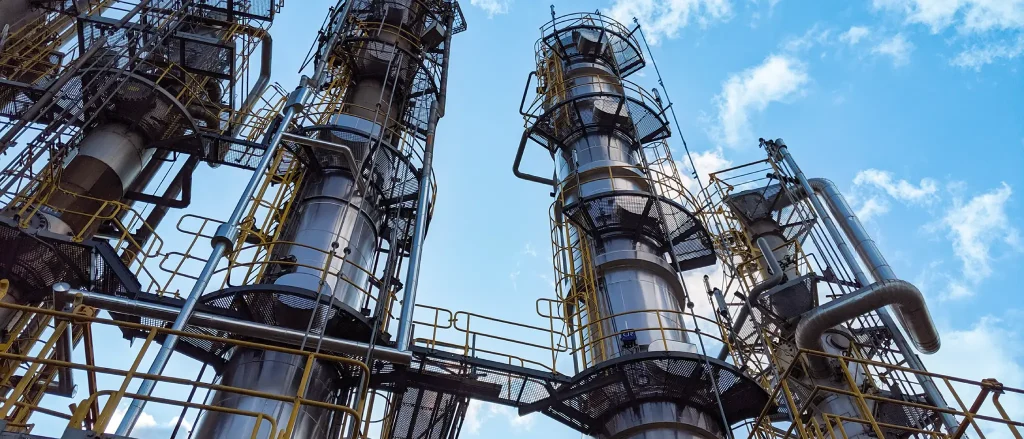
API 583 is an industry standard focused on Corrosion Under Insulation (CUI) in sectors like oil and gas and petrochemicals. It offers guidance on the prevention, detection, and mitigation of CUI risks through inspection strategies, materials selection, and corrosion monitoring. Following API 583 helps safeguard assets, improve safety, and extend equipment life. The standard emphasises proactive measures and continuous assessment to ensure asset integrity and operational efficiency.
API 583 stipulates for Inspection of Piping Operating Below 32 °F (0 °C)
“In these services, the removal of insulation on operating equipment is undesirable because wet and icy conditions make it difficult to inspect. It also exposes the insulation to atmospheric water vapour, trapping more moisture within the insulation prior to re-insulation of the area.”
What one should remember is that for cryogenic services it is advisable to not remove the insulation and opt for other NDT techniques unless an adequate insulate repair is planned. For example, enough overlap on the existing undamaged vapour barrier.
API 583 Section 11.3
“For cold insulation, the vapor barrier of the replaced area should be applied with sufficient overlap on the existing undamaged vapour barrier”
Other information to be remembered is that CUI on carbon and low-alloy steels usually is of a localised aspect but in sweating service may have general corrosion with localised corrosion occurring at locations with coating failure.
Sweating service is a main concern for cold insulation vessels. This is why it is essential to properly insulate cold vessels. Without insulation, cold vessels would “sweat” just like a glass of ice water on a hot day. The air around is cooled below the dew point, and thus condensation begins to form. This is the main reason why cold insulation shall be vapour proof not only weatherproof using an insulation vapour retarder. Water vapour air born shall not enter beneath the insulation. This is why also if cold insulation is damaged it shall be repaired quickly and adequately.
You can (not for API 510 exam purposes) dig further into the matter by turning to API 583. We can for example quote the following interesting information.
API 583 Section 6.1.1.
Low-temperature insulations typically include polyurethane, polyisocyanurate, flexible elastomeric foams, cellular glass, and phenolics.
These insulation types normally require a vapour barrier under the outer weatherproofing to minimise the potential for condensation of atmospheric moisture.
API 583 section 6.1.4.2 Mineral Fibre
Mineral wool insulation is vapour permeable. For this reason, mineral wool insulation is always used in combination with other materials for cryogenic applications where condensation can occur.
API 583 section 9.3.6 Vapour Barrier
A vapour barrier is required for cold service applications. This barrier should be continuous and is usually provided by a glass fibre-reinforced mesh with three coats of elastomeric material. This elastomeric material should be compatible with the insulation material and flexible at the lowest expected ambient temperature. If it is to be left uncovered (i.e. unprotected by metallic weatherproofing), the vapor barrier should be resistant to solar radiation.
To summarise
• API 583 focuses on Corrosion Under Insulation (CUI) in the oil, gas, and petrochemical sectors.
• It provides guidance on the prevention, detection, and mitigation of CUI risks through inspections and corrosion measurements.
• Proactive measures and continuous assessment ensure asset integrity and operational efficiency.
• For piping below 32 °F (0 °C), removing insulation is discouraged due to difficulties in inspection and increased moisture trapping.
• Non-destructive testing (NDT) techniques should be used, with proper insulation repair and vapor barrier overlap.
• CUI on carbon and low-alloy steels can be localised, with sweating service causing general corrosion at coating failures.
• Properly insulating cold vessels is crucial to prevent sweating.
• Damaged insulation must be promptly and adequately repaired.
• The standard highlights various insulation materials and emphasises the need.